PROJECT WORK
A SUMMARY OF MY CURRENT RESEARCH AND MY UNDERGRADUATE PROJECTS THAT I FOUND VERY FUN
RESEARCH

ELASTOGRANULAR COLUMNS
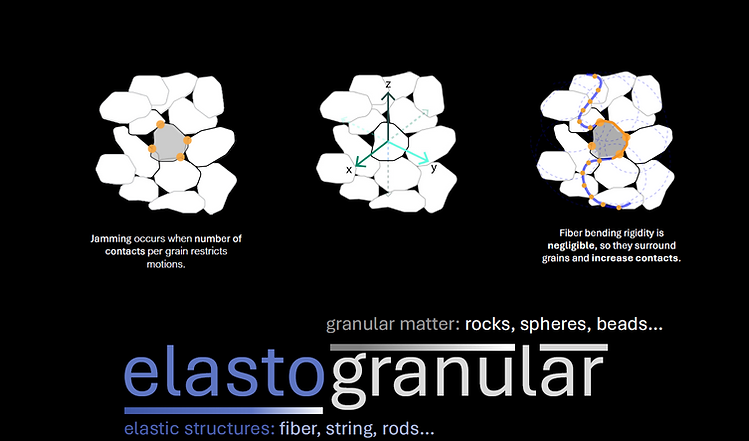
An elastogranular column is a stable column of grains (granular component) bounded by external string (elastic component). A preload, is applied to the column resulting in a new material with new mechanical properties.
We used the well established fundamentals of granular and fiber jamming in combination with high-strength fibers, such as Dyneema, to create load-bearing structures capable of withstanding really large loads. The column pictured can withstand loads exceeding 50kN in uniaxial compression. The goal of this research project was to create a temporary and quick solution for air-field damage repair applications compared to traditional backfilling techniques. We scaled our tabletop design for larger scale crater demonstrations and proved that this technique outperformed traditional methods with the least amount of rutting.


A scaled up version using larger rocks ad thicker gauge Dyneema rope that is glued together with a bioeffector adhesive as opposed to concrete or cement.

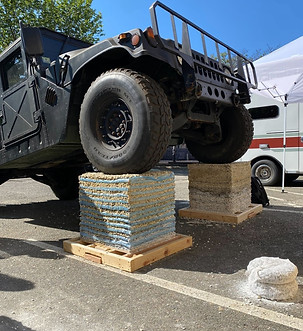
2' x 2' x 2' boxes using different methods (randomized assortment of Dyneema fibers and Dyneema textile). Designs were further scaled to 8' x 8' x 2' craters (not pictured).
Custom Velostat pressure sensor for a confined elastogranular system


The goal of this sub-project was to measure the resulting lateral forces exerted on the walls of the container in our benchtop experiments as a uniaxial compressive load is applied. We rescaled and redesigned our set-up using a box configuration, which was most analogous to the craters at the larger scale site demonstrations. We focused on the static loading case for simplicity and considered both a distributed, as well as a point load. I designed and fabricated the sensor array made from velostat, copper tape, and an insulating material. I also designed the electrical circuit to be connected to the system as illustrated below. Once complete, I calibrated the system, and converted the readings into force data as depicted in the video.

UNDERGRADUATE PROJECTS
MAJOR QUALIFYING PROJECT (MQP)
SENIOR THESIS
Hearing through Haptics
The goal of this project was to develop a portable, planar and non-invasive wearable device that is independent of the vestibular nerve and does not inhibit user behavior. The device is intended to provide audio-spatial awareness by using haptic vibrations for sensory substitution to sense urgent safety alerts (i.e. alarms, sirens) and social interaction cues. Using three-dimensional arrangements of actuator and microphone pairs and input signal filtering through a microcontroller, sound sources can be identified and directionally located, indicated to the user via actuator vibrations.


Prototype 1
Laser etching technique on copper sheets
Prototype 2
Testing Prototype 2
Finding the impedance
Manufacturing set-up for copper coil in Prototype 2 design
Final Design
1. Animation of the exploded design
2. Schematic of assembly
Final Design
Vibrometer analysis
Electrical Circuit Design
Microphone Assembly
Casing for electrical components
iRobot ROOMBA PROJECT
iRobot challenged us by asking students to create a device that turns bulk cotton into small fibers to simulate hairs on a carpet in customers’ homes. My team and I created a prototype that we believe is an effective solution for the problem given to us by iRobot. During the seven week course, we assessed the problem statement and worked together as a group to think of as many solutions as possible. Once we were able to brainstorm ideas, we focused on key features we believed would be the best solution and started to engineer a device that iRobot would find effective.


PORTABLE SPEAKER
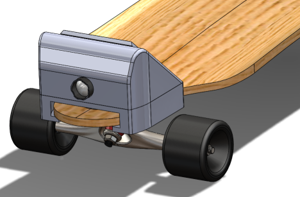
Zoom n' Boom
The objective of this particular project was to create a portable speaker that delivered good acoustic quality. With that being said, my team and I wanted to take things a step further. We wanted to create something that was fun, lighthearted and had never been done before. We looked at the different niche markets that existed and those that didn't. That's how we came up with the concept of 'Zoom n' Boom', a portable speaker for longboard riders. This prototype is essentially designed for your average longboard user who likes to listen to music on rides but would also like to remain aware of their surroundings while minimizing sound spill.